| azelie studio |
november 2026 |
|
|
Hi. It’s been a minute. |
The last time I landed in your inbox was May. I spent the months since rebuilding how this business works, because what a brand actually needs from someone like me is not what it needed a year ago. Rethinking this letter was part of the same stretch. (I’d have preferred a sabbatical. Nobody offered.) |
Here’s where I landed. The foundations of brand and marketing haven’t moved. Almost everything about how the work gets done has. From now on, this letter is about that. One idea a week. |
If that’s not for you anymore, the unsubscribe link is at the bottom and there are no hard feelings. If it is, I have some news about your role. |
|
Sometime in the last few years, your job changed. |
There was no meeting about it. Nobody sent a calendar invite, which may be the only time that has ever been true of anything at work. |
Until recently, marketing with a lean team meant making things by hand. An email took an afternoon. A one-pager took a week and three rounds of “can we make the logo bigger” (depending on which side of that email you were on). |
Now a draft of either one shows up in under a minute, and on the surface, it looks finished. The grammar is clean. Cleaner than what I would have typed at 4 p.m. on a tired Tuesday… even if the actual soul is missing. (I’ve made my peace with the grammar part. Mostly.) |
|
So what are you for? |
|
Here’s what I think happened. You didn’t get replaced. You got promoted to Creative Director. (Congrats!) |
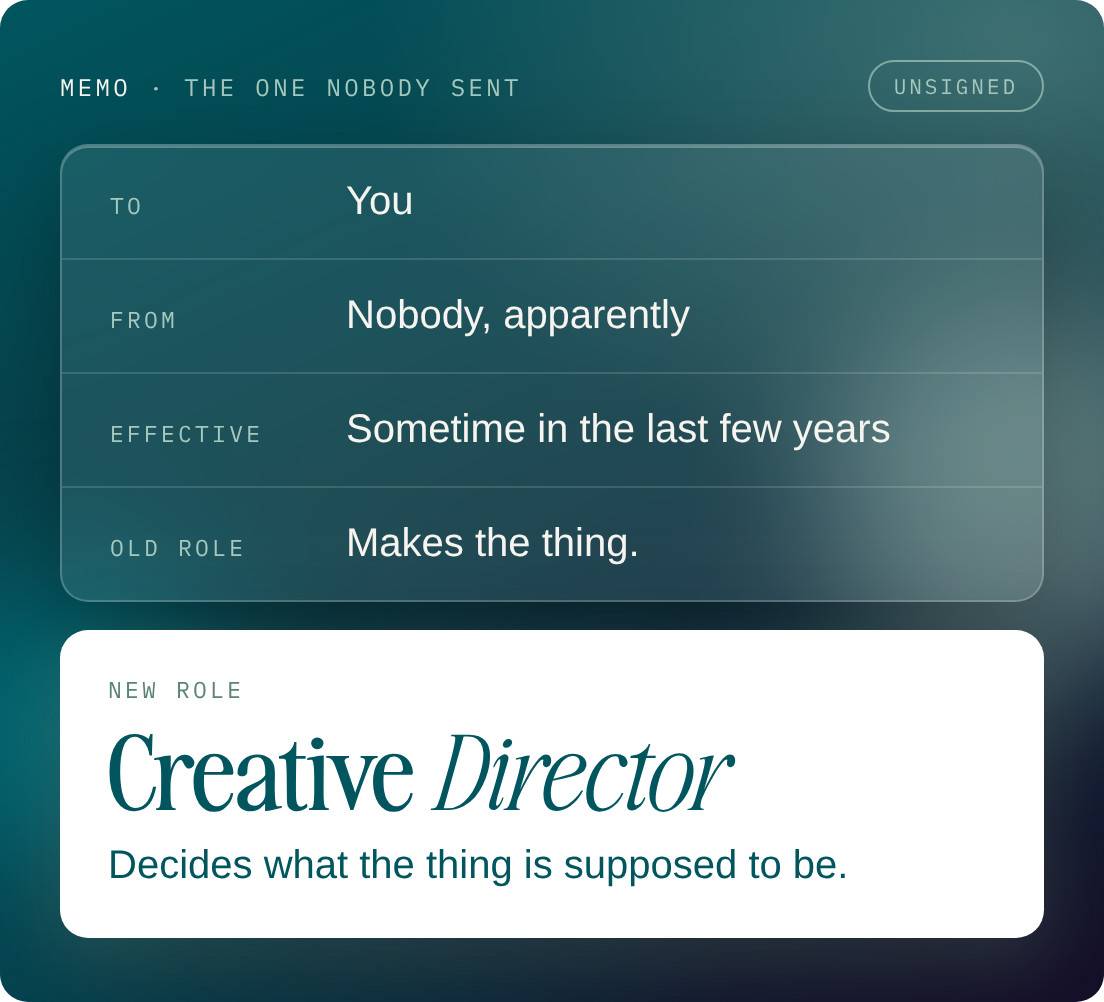 |
And like most promotions, it came with no announcement, no raise, and no sad sheet cake in the break room. What it did come with is a room full of tireless interns who work for twenty dollars a month and have never met a single one of your customers. Nobody got the onboarding. |
|
Before this, I was the entire marketing department at a growing company. No team under me, a seat at the leadership table, and a list that never got shorter. I loved that job. |
In a company that size, the job was never only making things. It was getting the right people in a room, asking the questions that pulled the answers out of them, and writing down what everybody already knew but had never said in one place. Who we were for. How we actually sounded. What we’d never say. Then carrying that across everything we made. “We” is the operative word. None of it was ever one person’s call. And somebody still had to say when a thing looked polished on the surface but wasn’t good enough to send. |
That was the job then. It’s everyone’s job now. |
Whether you’re the founder wearing the marketing hat at 8 p.m. or the one-person marketing team running the whole show, you are no longer just the person typing the words. You are the one who knows what the piece is supposed to be. AI can take over the first draft. Which means your whole job is now the creative work. |
That isn’t less work than writing it yourself. It’s different work, and I’d argue it’s harder. Typing was never the hard part. |
|
| 01 |
Two things to stop doing |
|
Stop counting how much got made this month. Ask what got turned down. And stop apologizing for not making it all by hand. Nobody is handing out points for typing. |
|
|
All of that only works if you know what the piece is supposed to be. And over the last few months, I’ve noticed something uncomfortable about how most companies actually run: |
They never actually had a documented brand. They just had a person. |
|
For years, companies got away with never writing their real point of view down because the founder, or the one marketer who knew the business inside out, was the filter. The instincts lived in your head. You knew how you actually talk to a client on the phone, which industry buzzwords make you cringe, and which promises you’d never make, because you edited the bad stuff out as you typed. |
The moment you hand the keyboard to AI, that invisible filter disappears. |
Most teams open a chat window with none of that gut instinct written down. Or worse, they feed it four polite adjectives from an old brand deck (approachable, trustworthy, modern, bold) and wonder why the machine still hands them work that could belong to anyone. A dentist. A software company. A dentist who owns a software company. |
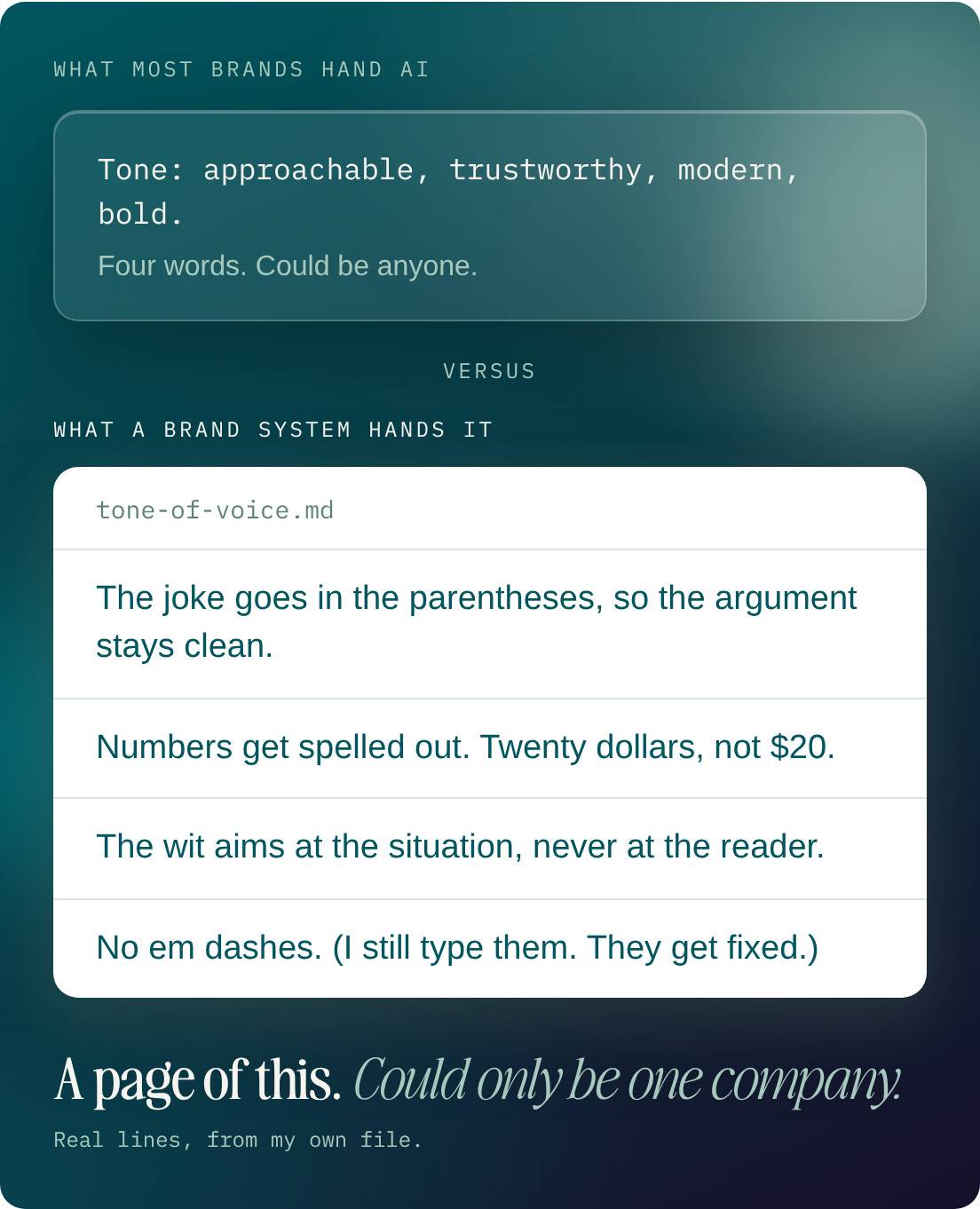 |
Because a brand isn’t made out of the polite adjectives you claim. It’s made out of your hard edges, and what you refuse to say. |
|
That’s the part I work on now. The instincts that used to live only in the owner’s or the marketer’s head, written down the way a sharp new hire would need them. Plain documents that AI tools can actually read, so the brand gets used instead of admired in a deck. Who it’s for. How it actually sounds. What it would never say. |
I call it the brand system. Once it exists, a founder or a team of one can direct an email, a one-pager, a proposal, and a slide deck in an afternoon, and all four sound and look like the same unmistakable company. The directing is still yours. You’ve just stopped explaining your own business from scratch every single time. What a time to be building a brand. |
More on that soon. |
|
Take your seat. |
Dani |
|
P.S. If your promotion did come with a raise or a sheet cake, hit reply and tell me where you work. (And if you’re the owner, you are legally allowed to buy yourself the cake.) |
azelie studio |